
3rd
New Venture Competition
1st
ME Capstone
Project Originator and Lead Engineer
Currently, there is no accurate way to predict underwater ocean visibility conditions. This leaves SCUBA divers, snorkelers, free divers and marine researchers always guessing at what the conditions might be, which wastes time, effort and money when they inevitably guess incorrectly. VizNet’s goal was to solve this problem by developing a solar powered, self-sustaining marine buoy which can directly measure and upload real-time ocean visibility conditions to the internet. This is accomplished with a turbidity sensor specially calibrated to ocean diving conditions. This product allows divers and researchers to check the conditions before they go out, removing the frustration out of the dive planning experience and allowing them to get the most out of their dives.

Project Origins:
Inspired by my own passion for diving, I pitched this idea to the mechanical engineering department at UCSB where it was judged alongside industry and research sponsored project proposals. After a rigorous selection process, my idea was chosen to receive the CNSI Innovation Grant and was the only student proposed project competing in UCSB mechanical engineering capstone this year. I was put in charge of a group of six engineers and built my leadership, communication and systems engineering skills through this project. I also learned how to design and test systems ocean deployed systems.

How It Works
The system measures visibility using a repurposed turbidity sensor that is originally used in industrial waste management settings. Our team went into the field, measured the visibility on various days and collected samples. These samples were used to carefully calibrated our turbidity sensor with real-world data. RS485 communication and a microcontroller were used to interface with the sensor.
Visibility data from the sensor was uploaded to the internet using a cellular communications shield controlled using an Arduino microcontroller. This data was processed and displayed to the end user by a specialized IoT server.
The structure of the buoy consisted of a fiberglass laminated foam cylinder (that I glassed myself) with an underwater counterweight set in the middle. Four 5W solar panels were supported by an anodized aluminum frame, and an IP67 rated waterproof box held the electric systems.
I directly worked on the engineering of the communications, structural and power subsystems, as well as the integration, management, and testing of the entire system.
.jpg)
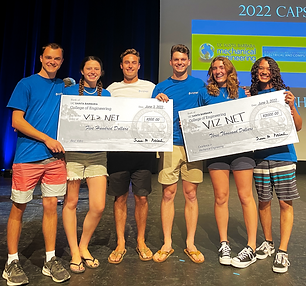
1st Place ME Project and Best Video
New Venture Competition
This project also competed in the New Venture Competition at UCSB, which involved creating a business model, financial projections, investor pitch and more which were judged by real-world venture capitalists. VizNet was the only team consisting entirely of undergraduates, and beat out dozens of other teams to claim 3rd place in the final competition.
.jpg)
