Past Projects


Wind Tunnel
Spring 2017
As a final project in my senior AP Physics class, myself and two other classmates built a wind tunnel in order to measure the lift vs angle of attack of various airfoils. The wind tunnel was constructed from wood and plexiglass and was driven by an industrial blower fan. The design consisted of a converging duct at the inlet with an air straightener of glued plastic straws and then a diverging outlet to the fan. The testing area used plexiglass so that the flow over the airfoils could be visualized using smoke. The airfoils were slid onto lubricated vertical rods such that their angles of attack could be adjusted and the lift force could be measured using a force gauge. We were able to find the stall points for each airfoil. This was by far the most ambitious project completed in the entire tenure of our physics teacher and required quite a bit of prior research.
Statics Bridge Competition
Fall 2018
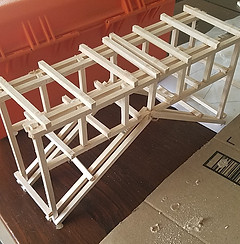
As a part of my mechanical engineering statics class, a bridge competition was held which was substituted for one of our midterms during the quarter. We were all given the same amount of 1/4'' balsa wood and elmers glue and had to construct a bridge that had the largest strength to weight ratio. At the end of two weeks, the bridges would all be tested in front of the class using a force meter stand. My partner and I started off by drawing up different designs and analyzing their truss systems using computer software. We then built a full bridge and weighted until failure. By analyzing the various weak points of the first design, we were able to produce a much stronger final bridge which ended up winning the competition. Our balsa wood bridge maxed out at over 175lbs, which beat the next best bridge by about 50 lbs and the average by over 100lbs.
Santa Barbara Oil Spill
Spring 2019
As a final project for my Matlab simulation class, I modeled the advection and diffusion of an oil spill originating from a pipeline located at one beach. This took into account basic ocean currents and calculated the concentration of oil on the 2D surface of the ocean throughout time. This gave the theoretical ability to choose which beaches along the coast to close during certain time periods. This is one of the most complicated simulations I have coded before and has given me confidence to discretize and simulate just about any governing equation in engineering.
Critical Temperature of YBCO Superconductor
Spring 2019
In my last underclass physics lab for physics majors, we had to choose a physical constant or property to experimentally measure and then compare to the accepted value. For my experiment I choose to measure the critical temperature of Yttrium Barium Copper Oxide (YBCO), which is the temperature at which the material transitions into a superconducting state. An RTD was used to measure the temperature of the sample and liquid nitrogen was used to cool the sample below its critical temperature. The transition out of a superconducting phase was determined by measuring the resistance of the YBCO sample and through the Meissner effect (hovering magnet). I wrote a report which summarizes the findings of this quarter long experiment. This paper is a great representation of my writing skills so I have included a link to it below.

Model of a Tidal Extraction Plant

Spring 2020
As a final project for my Wind and Tide class, I chose to model a potential tidal extraction farm. This included choosing a suitable location and characterizing the expected tidal changes. I designed and justified a turbine and analyzed the different flow and power parameters associated with the design. The entire course material has focused mostly on wind energy, so this was a big challenge that required a lot of separate research on my part and applying the concepts I've learned to a different medium which posed its own unique issues.

.jpg)
Interactive LED Punching Bag
Spring 2020
For one of my mechanical engineering design courses, I constructed an interactive punching bag that utilized LEDs to instruct the trainee where and how to strike the bag. The reinforced, individually addressable LED strips were wrapped around the bag at different heights and controlled by an Arduino. Different colors represented different kinds of strikes (jab, uppercut, side kick, front kick etc.) and the trainee would strike wherever the LEDs were lit up. Through this project, I learned to prototype with a limited budget (<$50) and to protect electronic parts from repeated impact loads.
COMSOL Simulation of Waves Striking a Pier
Fall 2021
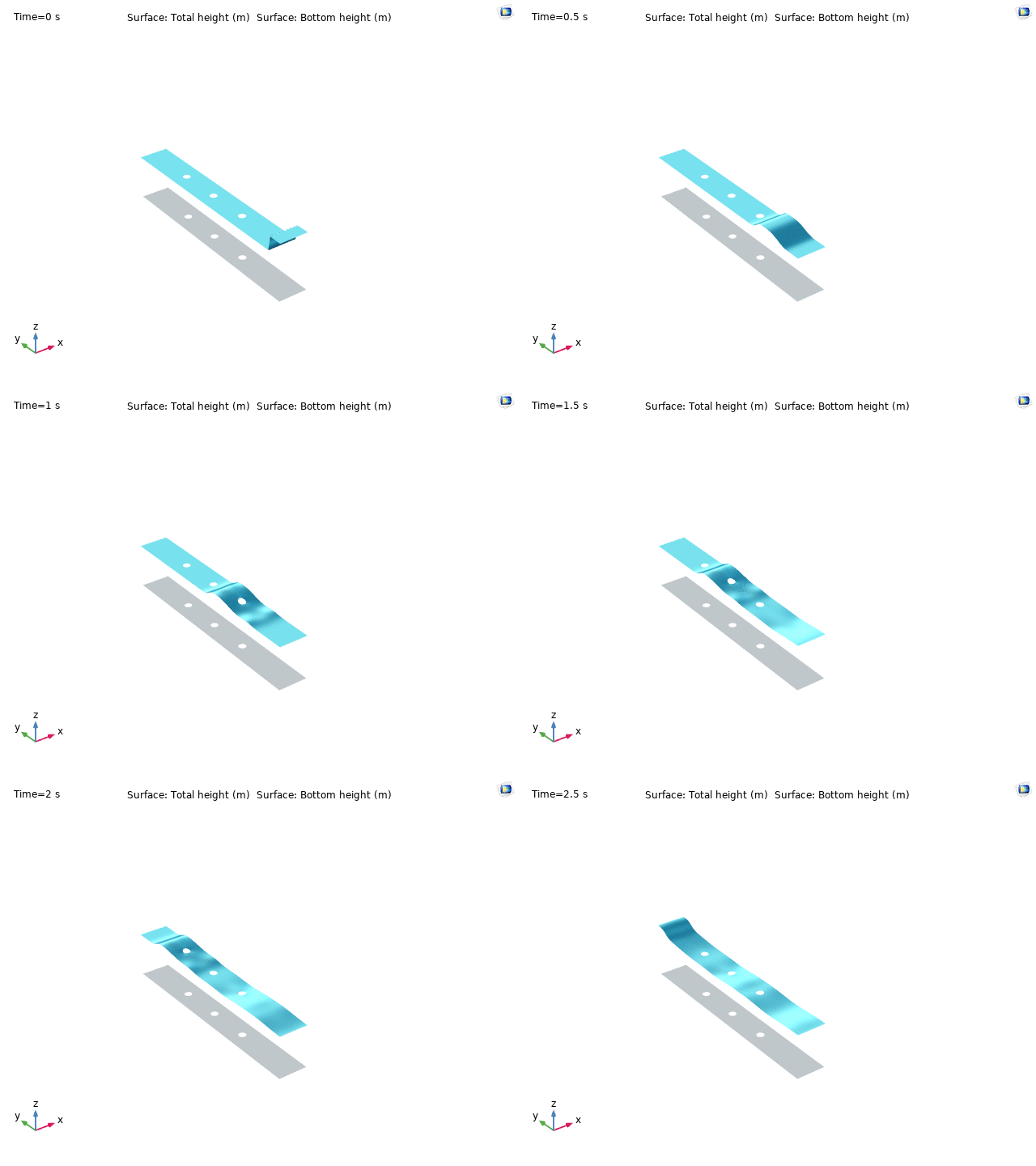
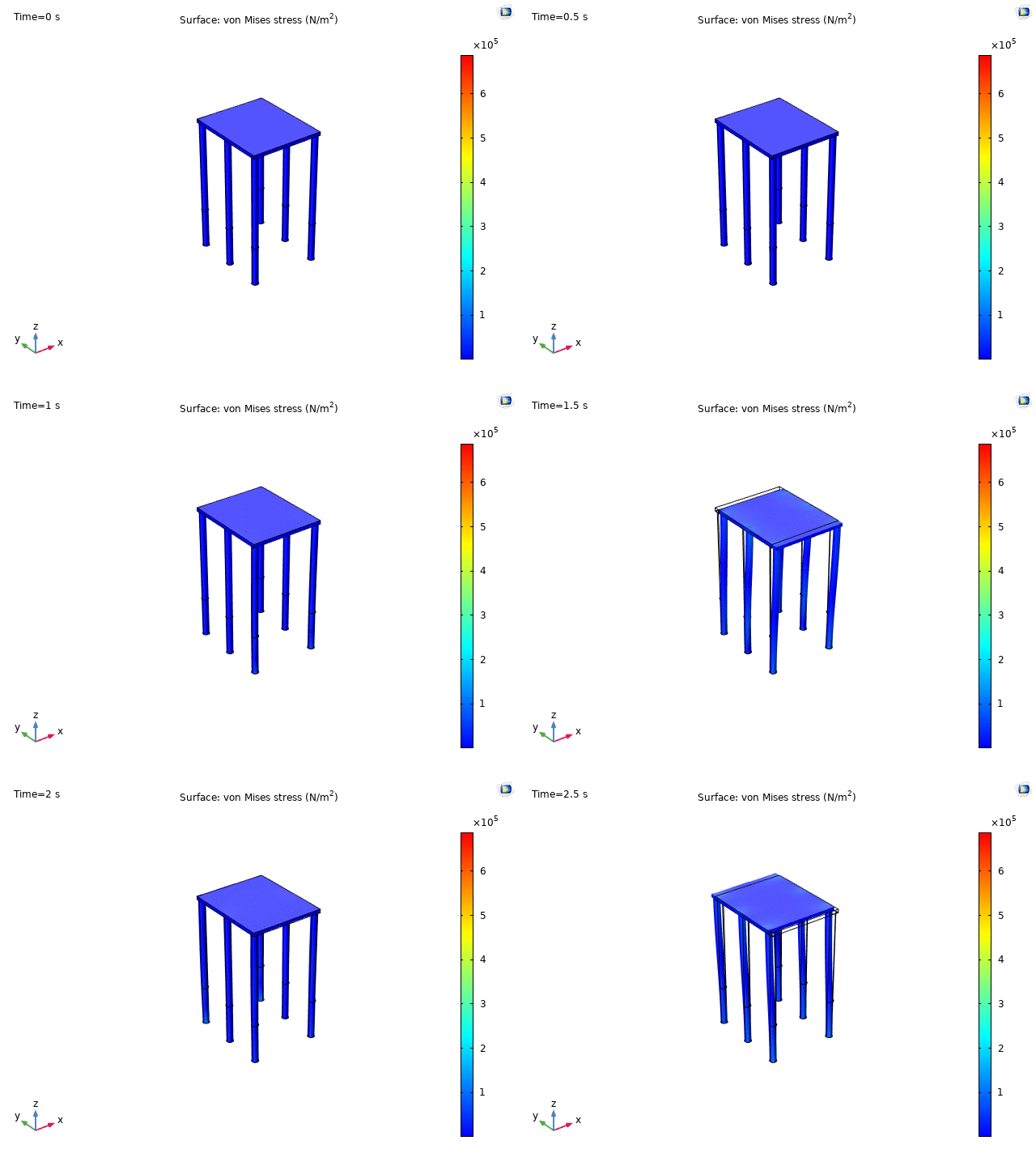
As a final project for my COMSOL multiphysics course, I explored the different variables that effect the force that waves can exert on structures. This culminated in applying these forces to a modeled wooden pier whose response was examined. This simulation utilized the Shallow Water Equations module in COMSOL to generate waves and cause them strike a series of columns. The force a wave exerts was seen to increase quadratically with the initial height of the wave, and an optimal wave propagation distance was observed for which a wave exerts it’s peak force. A 1m tall wave was modeled to strike three pier legs, and the measured stress was less than the ultimate tensile strength of the material. An eigenfrequency analysis was also preformed on the pier structure, which determined that a resonance scenario caused by sinusoidal wave forces was unlikely.